Showing posts with label Chicago. Show all posts
Showing posts with label Chicago. Show all posts
Chicago Skyline
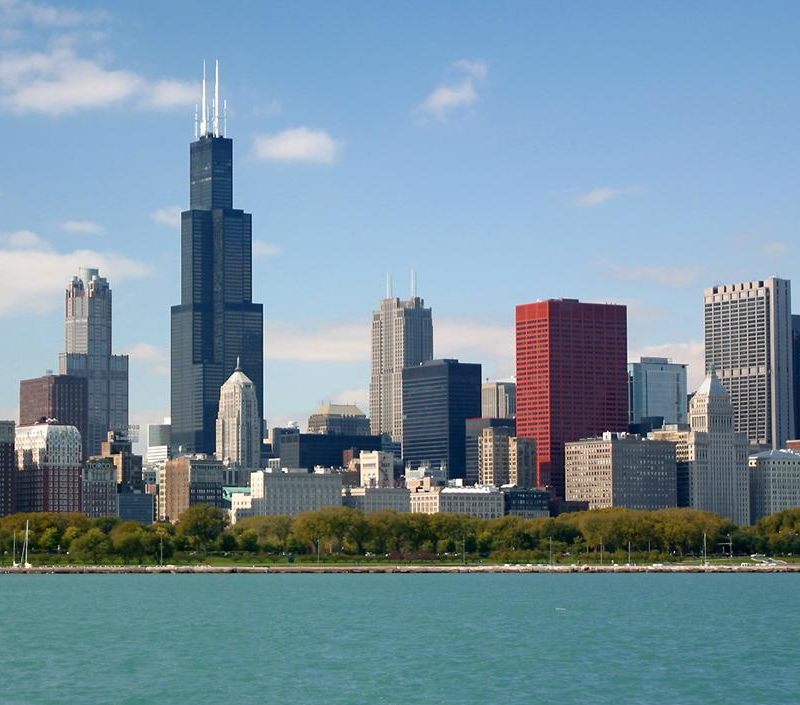
The buildings in the foreground of this photograph stand along Michigan Ave, which did indeed once run beside Lake Michigan. Despite many efforts by commercial interests to cut it up, Grant Park now stands along the lakeshore, protected by the protests of the people of Chicago under the leadership of public figures like department store magnate Montgomery Ward. Just as Central Park in New York acts as the lungs of that city, so does Grant Park provide a welcome green carpet next to the blue lake. Nevertheless, the skyline with its tall buildings is magnificent, quite appropriate for a place which is often considered the birthplace of the skyscraper, epitomized by the large black Sears Tower, tallest building in the United States.
 Chicago Skyline
 Chicago Skyline
 Chicago Skyline
 Chicago SkylineLeaving the artificiality of the city's concrete canyons, we head across Michigan Avenue to Grant Park, a very welcome antidote to the glass, steel and tarmac. The centerpiece of this large park, which is just a small part of the lakeside green strip which runs for many miles north and south of downtown, is Buckingham fountain, named after the brother of its donor, Kate Buckingham. Built in 1927, it's twice the size of its model, the Bassin de Latone at Versailles, and shoots a stream of water worthy of Chicago 150 feet into the air. It performs its display throughout the warmer months, both by day and illuminated at night.
Buckingham fountain (click here to open a new window with this photo in computer wallpaper format)
 Chicago Skyline
 Chicago Skyline
 Chicago SkylineIt's good to have photographs like this around to remind me why I left Chicago, twice. At times it seemed like Chicago was a giant black hole relentlessly sucking me in, even before I was living in America. I well remember the awful "Noo Joisey" accent of a recruiter calling me at two thirty in the morning as I and my family in New Zealand were trying to sleep; whether she did this out of ignorance or lack of respect I'll never know, but even then I knew enough about Chicago's climate not to want to live there. Nevertheless, after nine months in the country, and the first death of a high-tech company that I was working at, I landed work with Motorola in Chicagoland, that great expanse stretching from Gary in Indiana, all the way up to the Wisconsin border, and perhaps beyond. After 12 months I quit and headed to the gentler climes of New Jersey, only to land up in Chicago yet again, after the death of another company. Eighteen more months and another commercial entity's near-death experience, and I moved down to a new job in Evanston, which is where this photo of downtown Chicago was taken from. On the far right of the photo is the Sears Tower, in the center the John Hancock center, which I always thought was more attractive than the Sears Tower, and on the extreme left you can just make out one of Indiana's few remaining steel mills belching out steam and smoke.
READ MORE - Chicago Skyline
Chicago SkylineChicago Skyline Chicago Skyline
 Chicago SkylineLeaving the artificiality of the city's concrete canyons, we head across Michigan Avenue to Grant Park, a very welcome antidote to the glass, steel and tarmac. The centerpiece of this large park, which is just a small part of the lakeside green strip which runs for many miles north and south of downtown, is Buckingham fountain, named after the brother of its donor, Kate Buckingham. Built in 1927, it's twice the size of its model, the Bassin de Latone at Versailles, and shoots a stream of water worthy of Chicago 150 feet into the air. It performs its display throughout the warmer months, both by day and illuminated at night.
Buckingham fountain (click here to open a new window with this photo in computer wallpaper format)
 Chicago Skyline
 Chicago Skyline
 Chicago SkylineIt's good to have photographs like this around to remind me why I left Chicago, twice. At times it seemed like Chicago was a giant black hole relentlessly sucking me in, even before I was living in America. I well remember the awful "Noo Joisey" accent of a recruiter calling me at two thirty in the morning as I and my family in New Zealand were trying to sleep; whether she did this out of ignorance or lack of respect I'll never know, but even then I knew enough about Chicago's climate not to want to live there. Nevertheless, after nine months in the country, and the first death of a high-tech company that I was working at, I landed work with Motorola in Chicagoland, that great expanse stretching from Gary in Indiana, all the way up to the Wisconsin border, and perhaps beyond. After 12 months I quit and headed to the gentler climes of New Jersey, only to land up in Chicago yet again, after the death of another company. Eighteen more months and another commercial entity's near-death experience, and I moved down to a new job in Evanston, which is where this photo of downtown Chicago was taken from. On the far right of the photo is the Sears Tower, in the center the John Hancock center, which I always thought was more attractive than the Sears Tower, and on the extreme left you can just make out one of Indiana's few remaining steel mills belching out steam and smoke.
Chicago
The buildings in the foreground of this photograph stand along Michigan Ave, which did indeed once run beside Lake Michigan. Despite many efforts by commercial interests to cut it up, Grant Park now stands along the lakeshore, protected by the protests of the people of Chicago under the leadership of public figures like department store magnate Montgomery Ward. Just as Central Park in New York acts as the lungs of that city, so does Grant Park provide a welcome green carpet next to the blue lake. Nevertheless, the skyline with its tall buildings is magnificent, quite appropriate for a place which is often considered the birthplace of the skyscraper, epitomized by the large black Sears Tower, tallest building in the United States.
 Chicago
 Chicago
 Chicago
 ChicagoNo-one has ever figured out whether this is meant to be an angel, a horse or a woman, and the artist didn't give a title to his work, so Chicagoans just know this statue outside the Daley Center as "The Picasso". Regardless of what it is, children love to slide down its sloping metal base.
Artwork like this one inspired a whole wave of statuary which gives the city a great deal of character, an effect which was strengthened by a local ordinance passed in 1978 which required developers to spend a certain percentage of their budget on such public displays.
A few of the other famous works include the 39 foot high Miro statue, which is almost directly opposite the Picasso, a very large glass and stone mosaic by Marc Chagall called "The Four Seasons", and a huge red steel girder creation called "Flamingo", visible below and right of the center of the previous aerial photo of Chicago.
 Chicago
 Chicago
 ChicagoYou might be forgiven for wondering why a place called "Navy Pier" would be located in the center of America's midwest, many miles from the ocean. In fact, Chicago really was a major naval port during the two world wars, and many soldiers did board troop ships on this half-mile long pier for the trip through the great lakes, down the St Lawrence river and across the Atlantic. Today the pier is the boarding place for tours of the harbor, and there are numerous attractions along its length, including a stained glass window and a 140 foot high ferris wheel, great grandchild of the world's first ferris wheel, which was constructed for the 1893 Chicago World Expo.
READ MORE - Chicago
ChicagoChicago Chicago
 ChicagoNo-one has ever figured out whether this is meant to be an angel, a horse or a woman, and the artist didn't give a title to his work, so Chicagoans just know this statue outside the Daley Center as "The Picasso". Regardless of what it is, children love to slide down its sloping metal base.
Artwork like this one inspired a whole wave of statuary which gives the city a great deal of character, an effect which was strengthened by a local ordinance passed in 1978 which required developers to spend a certain percentage of their budget on such public displays.
A few of the other famous works include the 39 foot high Miro statue, which is almost directly opposite the Picasso, a very large glass and stone mosaic by Marc Chagall called "The Four Seasons", and a huge red steel girder creation called "Flamingo", visible below and right of the center of the previous aerial photo of Chicago.
 Chicago
 Chicago
 ChicagoYou might be forgiven for wondering why a place called "Navy Pier" would be located in the center of America's midwest, many miles from the ocean. In fact, Chicago really was a major naval port during the two world wars, and many soldiers did board troop ships on this half-mile long pier for the trip through the great lakes, down the St Lawrence river and across the Atlantic. Today the pier is the boarding place for tours of the harbor, and there are numerous attractions along its length, including a stained glass window and a 140 foot high ferris wheel, great grandchild of the world's first ferris wheel, which was constructed for the 1893 Chicago World Expo.
Condo Hotels Appeal to Baby Boomers Seeking a Vacation Home
Condo Hotels Appeal to Baby Boomers Seeking a Vacation Home
by Joel Greene
Baby boomers interested in buying vacation homes are now considering one of the latest trends in second home ownership: the condo hotel.
Condo hotels are a type of vacation home. They are typically located in resorts operated by some of the top luxury hotel chains, such as Marriott, Ritz-Carlton, Hilton, and Trump International, to name a few.
These upscale second homes made their debut in Miami, but the condo hotel trend has now spread across the country to markets like Orlando, Las Vegas, Chicago, and to various cities in California, Colorado and New York. They are also quite popular in exotic locales such as Mexico, Panama, the Caribbean and Dubai.
Condo hotels are a perfect fit for the lifestyle baby boomers enjoy, providing luxurious, hassle-free second homes, without all the worries of maintenance. They offer baby boomers the opportunity for easy, relaxed family vacations in desirable locations without time spent researching, planning and booking travel accommodations.
Unlike traditional vacation homes, condo hotels are furnished condominium suites located within some of the country's most famous hotels and resorts. Owners of these suites are entitled to use all of the luxury amenities and services offered by the property, such as fine dining restaurants, fitness centers, spas, and concierge services.
Furthermore, the headaches of maintenance, guest services and housekeeping are assumed by the on-site hotel management company.
But what really sets condo hotels apart are that the individual owners can place their unit in the hotel's rental program when they're not there. The hotel management takes on the responsibility of finding and dealing directly with renters, leaving the owners free from these duties. The rent revenue the condo hotel unit generates helps offset the costs of ownership.
Many baby boomers looking for investment alternatives see condo hotels as a smart choice, a means to diversify into something other than stock market holdings. Because of a limited supply of land in many choice locales, the likelihood of capital appreciation on condo hotel units is increased.
Condo hotel units come in a variety of sizes and prices, typically ranging from $300,000 to over $1 million for prime properties.
Unlike a timeshare, which usually provides only a week or two per year of use, condo hotel owners are fully deeded property owners who can generally use their condo suites when and how they please. Baby boomers want vacation homes that are available when their busy schedules allow them time off.
Also, whereas traditional timeshares can be difficult to resell, condo hotels, with their luxury amenities, prime locations, limited inventory, and potential for appreciation, can be resold more readily.
For all these reasons, the condo hotel product, and the lifestyle if offers, appeals to the baby boomer generation. Look for more condo hotels to come on the market in coming years to meet this burgeoning demand.
READ MORE - Condo Hotels Appeal to Baby Boomers Seeking a Vacation Home
by Joel Greene
Baby boomers interested in buying vacation homes are now considering one of the latest trends in second home ownership: the condo hotel.
Condo hotels are a type of vacation home. They are typically located in resorts operated by some of the top luxury hotel chains, such as Marriott, Ritz-Carlton, Hilton, and Trump International, to name a few.
These upscale second homes made their debut in Miami, but the condo hotel trend has now spread across the country to markets like Orlando, Las Vegas, Chicago, and to various cities in California, Colorado and New York. They are also quite popular in exotic locales such as Mexico, Panama, the Caribbean and Dubai.
Condo hotels are a perfect fit for the lifestyle baby boomers enjoy, providing luxurious, hassle-free second homes, without all the worries of maintenance. They offer baby boomers the opportunity for easy, relaxed family vacations in desirable locations without time spent researching, planning and booking travel accommodations.
Unlike traditional vacation homes, condo hotels are furnished condominium suites located within some of the country's most famous hotels and resorts. Owners of these suites are entitled to use all of the luxury amenities and services offered by the property, such as fine dining restaurants, fitness centers, spas, and concierge services.
Furthermore, the headaches of maintenance, guest services and housekeeping are assumed by the on-site hotel management company.
But what really sets condo hotels apart are that the individual owners can place their unit in the hotel's rental program when they're not there. The hotel management takes on the responsibility of finding and dealing directly with renters, leaving the owners free from these duties. The rent revenue the condo hotel unit generates helps offset the costs of ownership.
Many baby boomers looking for investment alternatives see condo hotels as a smart choice, a means to diversify into something other than stock market holdings. Because of a limited supply of land in many choice locales, the likelihood of capital appreciation on condo hotel units is increased.
Condo hotel units come in a variety of sizes and prices, typically ranging from $300,000 to over $1 million for prime properties.
Unlike a timeshare, which usually provides only a week or two per year of use, condo hotel owners are fully deeded property owners who can generally use their condo suites when and how they please. Baby boomers want vacation homes that are available when their busy schedules allow them time off.
Also, whereas traditional timeshares can be difficult to resell, condo hotels, with their luxury amenities, prime locations, limited inventory, and potential for appreciation, can be resold more readily.
For all these reasons, the condo hotel product, and the lifestyle if offers, appeals to the baby boomer generation. Look for more condo hotels to come on the market in coming years to meet this burgeoning demand.
Subscribe to:
Posts (Atom)


